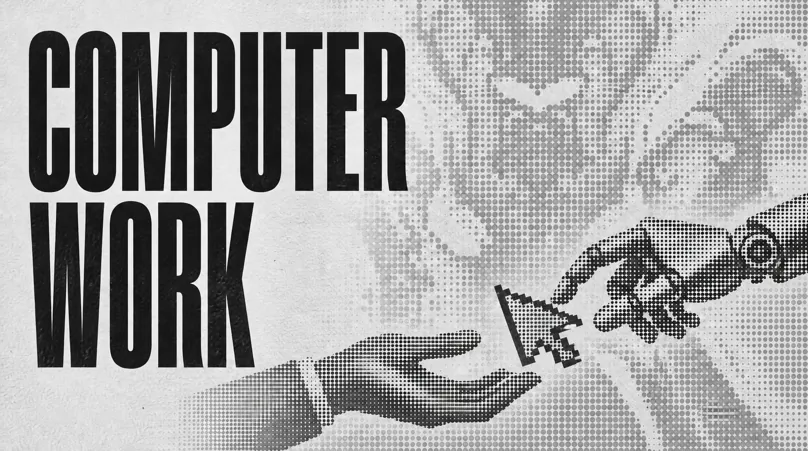
Why computer work should become optional
Computers were supposed to remove work. Instead, they created a second layer of work between intention and outcome. That layer should no longer be mandatory.
Computer work is the work required to make the computer produce the thing you actually wanted. Opening, finding, copying, sorting, renaming, uploading, formatting, checking, retrying, and remembering the state of every unfinished process are not usually the goal. They are the toll.
- Computer work is an interface burden, not a natural law.
- Automation that still needs constant supervision has only moved the burden.
- Optional does not mean forbidden. A person can always step in.
- The system must hold context, authority, and evidence without a human maintaining them by hand.
The hidden second job
Most knowledge work now contains another job inside it: operating the computer. A person may want to understand a market, support a customer, prepare a report, coordinate a shipment, or make a film. Before reaching that outcome, they manage tabs, file formats, logins, notifications, forms, and software boundaries.
We became so accustomed to this layer that we treat fluency with it as intelligence. The fast operator appears productive because they can move through the machinery without getting caught. But speed at navigating the tollbooth is not the same as removing the toll.
Conventional automation helps only when the work follows a path someone predicted in advance. The moment the environment changes, the person returns to diagnose the break, restore context, and decide what the machine should do next. The automation can execute, but the human still owns continuity.
Optional is the important word
We are not arguing that people should never touch a computer. Computers can be instruments for play, curiosity, creation, and precision. The point is agency: using one should be a choice, not the price of participating in modern life.
A person should be able to inspect a draft, change a direction, approve a consequential action, or take direct control. They should not have to keep every workflow alive through attention. The distinction is between judgment and clerical maintenance.
This also changes how we talk about autonomy. The goal is not a theatrical machine that appears independent. The goal is a dependable system that knows its assignment, recognizes its limits, requests approval when needed, and leaves enough evidence for a person to understand what happened.
The computer has to carry continuity
A chat window cannot remove computer work on its own. It usually has temporary context, borrowed access, and no durable environment. When the conversation ends, the person still has to organize the files, remember the plan, reopen the tools, and transfer the result.
That is why eFreedom is building ERIKA as an operating system. Identity, memory, goals, browser access, files, accounts, permissions, evidence, and recovery sit below any one model. The model can change while the resident and its work continue.
The physical version follows the same logic. A small computer of the agent's own can stay present without borrowing a person's laptop or requiring a monitor. The ambition is direct: plug it into the wall, define what it may do, and let the computer carry the computer work.
That is the threshold we care about. Not whether a model can complete a demonstration, but whether a person can stop being the operating system around it.