

One OS.
One agent.
A complete operating system built around an AI resident, not a person at a screen.
Enter the systemResident first.
ERIKA begins with a persistent resident and builds the machine around it.
Identity, memory, tools, permissions, evidence, and recovery stay together from the first instruction.

01 / THE OPERATING SYSTEM
One resident.
Three strata.
- Environment
Tools, accounts, permissions, and the place where work happens.
- Browser
Native access to the web without pretending to be a human moving pixels.
- Files + memory
Durable context, evidence, and work that survive the next model call.

02 / THE INTERFACE
No human-shaped detour.
Traditional operating systems assume a person will interpret pixels, move a pointer, manage windows, and remember what happened. ERIKA keeps the web and software, but removes the human-shaped layer between the agent and its work.
03 / CONTINUITY
What the OS owns.
Identity, memory, work, authority, and recovery stay with one resident over time.
- 01
Identity
One running ERIKA instance belongs to one resident. Models can change. Identity does not.
- 02
Memory
Context, goals, commitments, and evidence remain attached to the resident.
- 03
Browser + files
Native places to read, make, organize, and return to work. No human-shaped interface in between.
- 04
Accounts + permissions
Credentials and authority live inside a governed system boundary, not loose prompt text.
- 05
Evidence + recovery
Actions leave records. Failed work can be inspected, resumed, or rolled back.
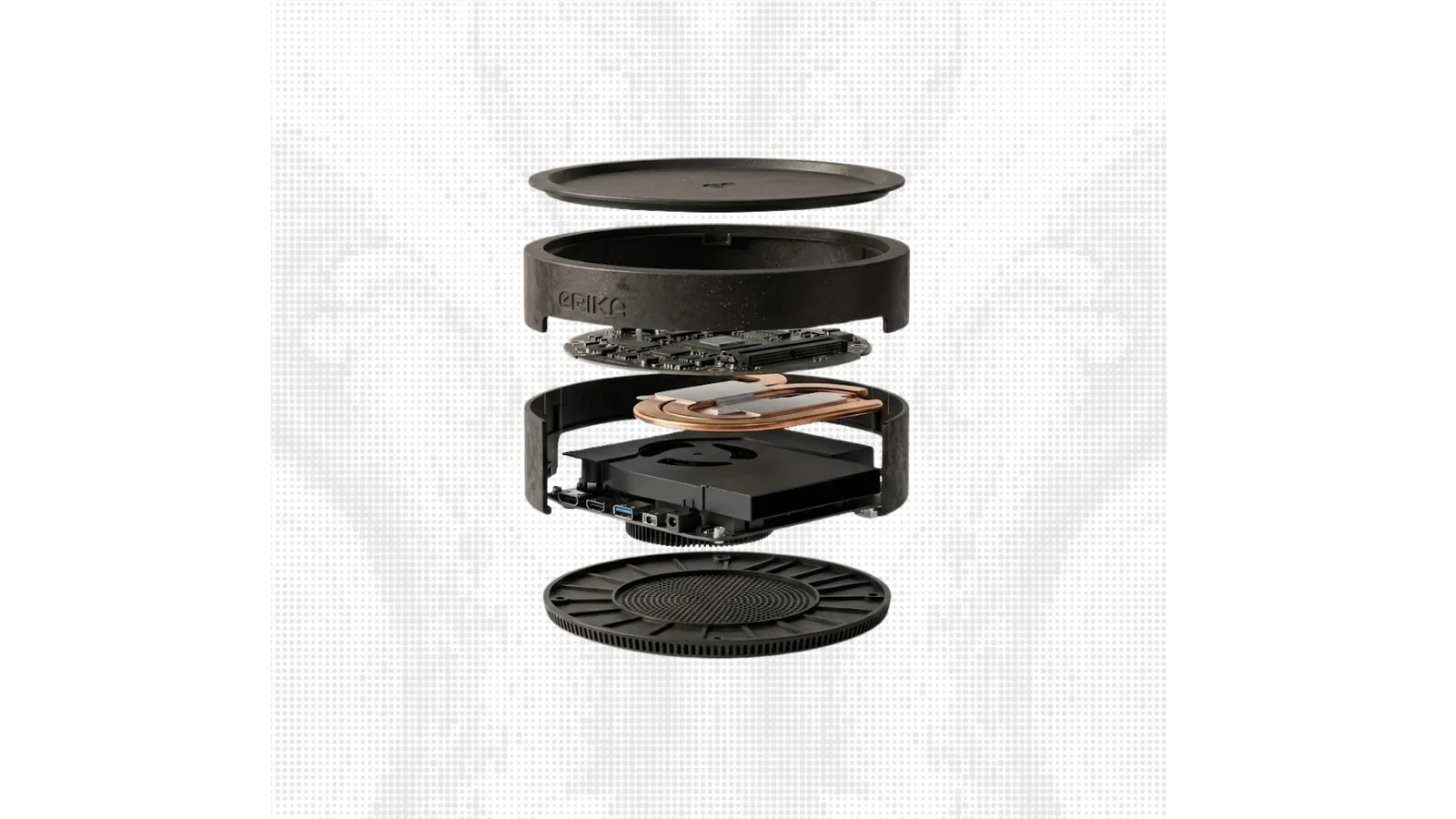
04 / THE BODY
The system can have a body.
ERIKA can run in a virtual machine or the cloud. It can also inhabit a computer built for it: a small, monitorless box that plugs into power and pairs from your phone.
Hardware is the body. The booted operating system is the agent.
Meet ERIKA, the computerCommon questions
What is an operating system, and why does that matter here?
An operating system is the software a computer starts up into, before any program runs. It decides what is allowed to run, what each program is allowed to reach, where files live, who the machine is logged in as, and what happens when something crashes. Windows, macOS and Linux are operating systems, and everything else you use is a program running on top of one. It matters here because the things a persistent agent needs most, like a stable identity and memory that survives a restart, are decided at that level and not by a program sitting above it.
How is this different from running an agent framework like OpenClaw or Hermes?
Those are programs you have to install and keep alive. You buy a machine built for a person, log into it, install the framework, wire up accounts and permissions, keep it awake, and maintain all of it yourself. The agent lives inside that arrangement and stops when it stops. With ERIKA there is nothing to install and nothing to log into. You plug ERIKA, the computer into the wall, pair it from your phone, and the machine is already the agent. Identity, memory, accounts, permissions and recovery belong to the operating system, so nothing has to be rebuilt after a restart.
How is this different from running an agent on a VPS or a virtual machine?
A VPS hands you a human operating system in a data center. You still log in, install things, and give an agent a shell inside an environment that was never designed for it, so the agent can only change what a program is permitted to change and everything it does is scripted around a system built for someone else. In ERIKA the operating system is the agent's environment, so its browser, files, permissions, evidence and recovery are surfaces it reads and acts on directly through the system itself, under rules the system enforces. The agent is not a guest on the machine. It is the resident.
What happens to everything my agent knows if I change the model?
Nothing happens to it. The model is a replaceable cognition provider, and identity, memory, goals, accounts, permissions and recovery belong to the operating system, so swapping the model does not swap the agent. Memory here carries provenance, permissions and expiry rather than being a saved transcript pasted into the next prompt.
Can I buy ERIKA or an ERIKA computer today?
No. Nothing is for sale, eFreedom has not set a price or opened orders, and no manufacturer has been chosen, because the hardware is deliberately sequenced to happen after the software is proven rather than before it. Anyone with a specific early use case can write to info@efreedom.com.
ERIKA is in active development. This page describes the architecture we are building, not a claim that every component is finished or every performance hypothesis is proven. We publish the work as it becomes testable.