
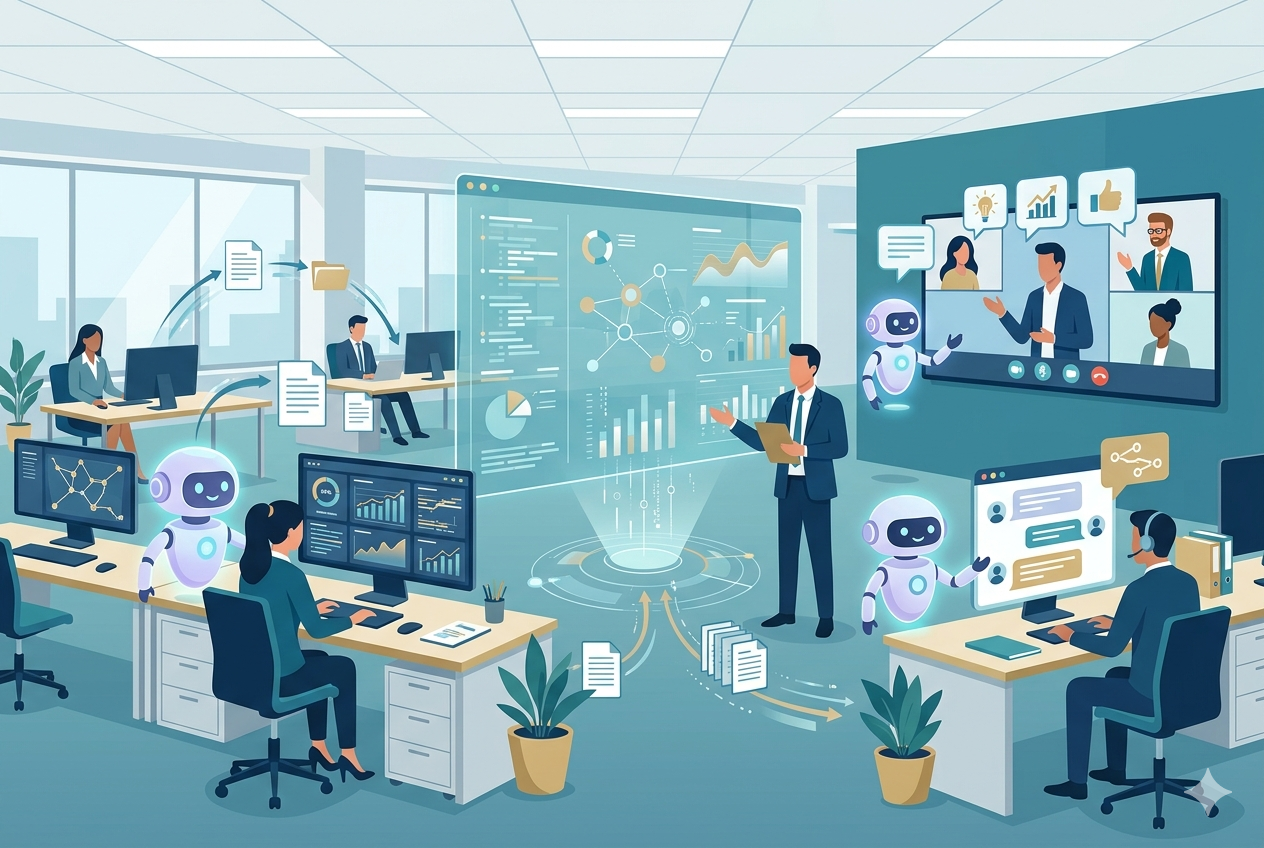
Businesses use AI agents to automate tasks, improve customer support, manage workflows, analyze data, and increase operational efficiency. These intelligent systems can perform repetitive work, assist employees, make real-time decisions, and help companies reduce costs while improving productivity, speed, and customer experience across multiple departments.
Introduction
Modern businesses are under constant pressure to move faster, reduce operational costs, improve customer experiences, and stay competitive in changing markets. Many companies struggle with repetitive tasks, communication delays, overwhelming data, and inefficient workflows that slow growth and reduce productivity.
This is where AI agents are changing the way organizations operate.
AI agents are becoming an important part of business operations because they can perform tasks independently, process information quickly, and assist teams in making better decisions. From customer service and marketing to finance and operations, companies are using AI agents to automate processes that once required large amounts of manual work.
Businesses are no longer using automation only for simple repetitive actions. Today’s AI agents can understand requests, interact with systems, analyze information, and respond intelligently in real time. This creates faster workflows, better accuracy, and more efficient teams.
As organizations continue to adopt digital transformation strategies, AI agents are becoming essential tools for improving productivity, scalability, and customer satisfaction.
What Are AI Agents?
AI agents are intelligent software systems designed to complete tasks with minimal human intervention. They can collect information, process data, make decisions, and perform actions based on instructions, goals, or learned behavior.
Unlike traditional automation tools that follow strict predefined rules, AI agents are more adaptive. They can interpret language, understand context, and respond dynamically to different situations.
In business environments, AI agents often act like virtual assistants, workflow managers, customer support representatives, scheduling coordinators, data analysts, or operational support systems.
These systems are commonly integrated into business platforms, communication tools, databases, and internal software to streamline daily operations.
The main purpose of AI agents is not to replace employees entirely. Instead, they help businesses reduce repetitive work so teams can focus on strategic, creative, and high-value tasks.
How AI Agents Work in Business Operations
AI agents operate by combining machine learning, natural language processing, automation systems, and business data. They receive inputs from users, applications, or workflows and then analyze information before taking action.
For example, an AI agent in customer support may receive a customer question through live chat. The system identifies the intent of the message, searches relevant information, and provides an accurate response within seconds.
In internal operations, AI agents can monitor workflows, detect delays, send reminders, generate reports, and manage repetitive administrative tasks automatically.
Many businesses connect AI agents with customer relationship management systems, email platforms, project management tools, inventory systems, and communication channels. This allows the AI system to work across multiple departments without interrupting existing operations.
The effectiveness of AI agents depends heavily on data quality, system integration, and clear operational goals.
Why Businesses Are Investing in AI Agents
Businesses are investing in AI agents because they solve real operational challenges that affect profitability and efficiency.
One major reason is time savings. Employees often spend hours handling repetitive tasks such as answering common questions, updating spreadsheets, scheduling meetings, processing requests, and organizing data. AI agents can automate many of these activities instantly.
Another important benefit is cost reduction. Businesses can reduce operational overhead by minimizing manual workloads and improving workflow efficiency. This does not necessarily mean reducing staff. In many cases, it means allowing employees to focus on more valuable work.
Scalability is another major advantage. Human teams have limitations in speed and availability, but AI agents can operate continuously without breaks. This helps businesses handle larger workloads, especially during peak demand periods.
Customer experience also improves significantly. Faster response times, personalized interactions, and consistent service create better customer satisfaction and stronger brand trust.
Businesses that adopt AI agents early often gain a competitive advantage because they can move faster, respond quicker, and operate more efficiently than competitors relying entirely on manual processes.
How Businesses Use AI Agents in Customer Service
Customer service is one of the most common areas where businesses use AI agents.
Companies use AI agents to answer customer inquiries, resolve common problems, process requests, and provide support around the clock. These systems can handle high volumes of conversations simultaneously, reducing wait times and improving customer satisfaction.
AI agents are especially useful for managing frequently asked questions, order tracking, appointment scheduling, account updates, and troubleshooting basic issues.
When customer concerns become more complex, AI agents can transfer conversations to human support representatives while providing context from previous interactions. This creates smoother customer experiences and reduces frustration.
Businesses also use AI agents to analyze customer conversations and identify recurring problems, allowing companies to improve products, services, and support processes over time.
How Marketing Teams Use AI Agents
Marketing departments use AI agents to improve efficiency, personalization, and campaign performance.
AI agents can analyze customer behavior, identify trends, segment audiences, and assist with content planning. They help marketers understand what customers want and when they are most likely to engage.
Businesses also use AI agents to automate email campaigns, social media scheduling, lead nurturing, and customer engagement workflows.
In sales and marketing environments, AI agents can qualify leads, respond to inquiries, recommend products, and support customer journeys through personalized interactions.
This allows marketing teams to focus more on strategy, creativity, and brand growth while reducing manual administrative work.
How AI Agents Improve Business Productivity
Productivity improves significantly when businesses reduce repetitive manual tasks.
AI agents help employees save time by automating scheduling, reporting, document management, data entry, workflow tracking, and communication processes.
Teams can complete projects faster because information flows more efficiently across departments. Delays caused by manual coordination are reduced, and employees spend less time switching between systems.
AI agents also help reduce human error. Automated systems can process large amounts of information consistently and accurately, which improves operational reliability.
Businesses that successfully implement AI agents often notice improvements in employee satisfaction because workers can focus on meaningful work instead of repetitive administrative tasks.
AI Agents in Data Analysis and Decision-Making
Modern businesses generate enormous amounts of data every day. Without proper analysis, valuable insights can easily be missed.
AI agents help organizations process and analyze data faster than traditional manual methods. They can identify trends, detect unusual patterns, generate reports, and provide actionable recommendations.
For example, businesses may use AI agents to monitor sales performance, customer behavior, operational efficiency, inventory levels, or financial activity.
Real-time insights allow managers to make faster and more informed decisions.
Instead of spending hours collecting and organizing data manually, teams can access automated insights that support smarter business strategies.
Common Industries Using AI Agents
AI agents are being used across many industries because automation and intelligent workflows are valuable in almost every business environment.
Retail companies use AI agents for customer support, inventory management, and personalized shopping experiences.
Healthcare organizations use AI systems to manage scheduling, patient communication, and administrative workflows.
Financial businesses use AI agents for fraud detection, transaction monitoring, customer assistance, and data analysis.
Logistics companies rely on AI agents to improve route planning, shipment tracking, and supply chain coordination.
Technology companies use AI agents extensively for internal operations, software support, and workflow automation.
Even small businesses are beginning to adopt AI agents because modern tools are becoming more accessible and affordable.
Common Mistakes Businesses Make With AI Agents
One common mistake is implementing AI agents without clear goals.
Some businesses adopt automation simply because it is trending, without understanding which operational problems they actually need to solve. This often leads to poor results and wasted resources.
Another mistake is relying too heavily on automation without maintaining human oversight. AI agents work best when combined with human judgment, especially for sensitive customer interactions or strategic decisions.
Poor system integration can also create problems. If AI agents cannot connect effectively with existing business systems, workflows may become fragmented and inefficient.
Businesses also make the mistake of ignoring employee training. Teams need to understand how AI agents work and how to use them effectively within daily operations.
Successful implementation requires planning, testing, ongoing monitoring, and continuous improvement.
Common Myths About AI Agents
Many people believe AI agents will completely replace human workers. In reality, most businesses use AI agents to support employees rather than eliminate them entirely.
Another common myth is that AI agents only benefit large corporations. Smaller businesses can also gain significant advantages from automation, especially in customer support, scheduling, and workflow management.
Some businesses assume AI agents are always expensive and difficult to implement. While advanced systems may require investment, many practical solutions are now accessible to companies of different sizes.
There is also a misconception that AI agents work perfectly without supervision. In reality, businesses still need oversight, updates, and performance monitoring to ensure systems remain accurate and effective.
Understanding these realities helps businesses adopt AI agents more strategically and realistically.
Why AI Agents Matter for the Future of Business
AI agents are becoming increasingly important because businesses need faster, smarter, and more scalable operations.
Companies that continue relying entirely on manual processes may struggle to compete as markets become more digital and customer expectations continue to rise.
AI agents help businesses operate more efficiently while improving adaptability and responsiveness.
As technology continues to evolve, businesses will likely use AI agents in more advanced ways, including predictive analysis, intelligent workflow coordination, and personalized customer engagement.
Organizations that learn how to integrate AI agents effectively today will be better prepared for future business challenges and opportunities.
Summary
Businesses use AI agents to automate tasks, improve workflows, reduce operational costs, and enhance customer experiences. These systems support teams by handling repetitive work, processing information quickly, and improving operational efficiency across departments.
AI agents are being used in customer service, marketing, finance, operations, data analysis, and project management. Their value comes from saving time, improving accuracy, supporting scalability, and helping businesses make faster decisions.
Successful implementation requires clear goals, proper system integration, employee collaboration, and ongoing optimization.
Key Takeaways
AI agents are transforming business operations by helping organizations automate repetitive tasks and improve productivity. Businesses are using these systems to create faster workflows, reduce errors, and improve customer experiences while allowing employees to focus on higher-value work.
The most effective use of AI agents happens when businesses combine automation with human oversight and strategic planning. Companies that adopt AI agents thoughtfully can improve efficiency, scalability, and long-term competitiveness.
AI agents are no longer limited to large enterprises. Businesses of all sizes are beginning to use intelligent automation to streamline operations and support sustainable growth.
Frequently Asked Questions
What do AI agents do in businesses?
AI agents help businesses automate tasks, manage workflows, analyze data, assist customers, and improve operational efficiency. They reduce repetitive work and support faster decision-making across different departments.
How are businesses using AI agents today?
Businesses use AI agents in customer support, marketing automation, scheduling, reporting, data analysis, sales processes, and operational management. These systems help improve productivity and customer experiences.
Can small businesses benefit from AI agents?
Yes, small businesses can benefit significantly from AI agents. Automation can help smaller teams save time, improve organization, and provide better customer support without requiring large operational budgets.
Do AI agents replace employees?
In most cases, AI agents support employees rather than replace them entirely. Businesses typically use AI agents to automate repetitive tasks while employees focus on strategic, creative, and relationship-based work.
Are AI agents difficult to implement?
Implementation difficulty depends on the complexity of the business and the systems being used. Many modern AI tools are easier to integrate than before, especially for common business functions like support and workflow automation.
Why are AI agents important for business growth?
AI agents help businesses scale operations, improve efficiency, reduce delays, and respond faster to customer needs. These advantages support growth and improve long-term competitiveness.
What industries use AI agents the most?
Industries such as retail, healthcare, finance, logistics, technology, and customer service use AI agents extensively because these sectors handle large amounts of data, communication, and repetitive operational tasks.
Conclusion
Businesses are increasingly using AI agents to create smarter, faster, and more efficient operations. From customer service and marketing to workflow management and data analysis, these systems are helping organizations solve real operational challenges while improving productivity and customer satisfaction.
The businesses that benefit the most are those that approach AI agents strategically, focusing on practical improvements rather than chasing trends. When implemented thoughtfully, AI agents can support long-term growth, improve team performance, and help organizations stay competitive in rapidly changing markets.
Companies that begin learning how to integrate intelligent automation today will be better positioned to adapt, scale, and succeed in the future.